The uncomfortable truth about buying birds and animals from pet shops, setting them free, and accidentally keeping the cage business alive.
You see a bird trapped in a tiny cage at a pet shop. It flutters its wings, grips the metal bars, and looks toward the open world outside.
Your heart sinks.
You think, Someone should save this poor creature.
So you buy it.
Maybe you take it home, give it food and water, and convince yourself that you have rescued a life. Or perhaps you open the cage and release the bird into the sky, watching it fly away with a sense of satisfaction.
You feel good. You feel kind. You feel like a hero.
But have you ever stopped to ask what happens after you leave that shop?
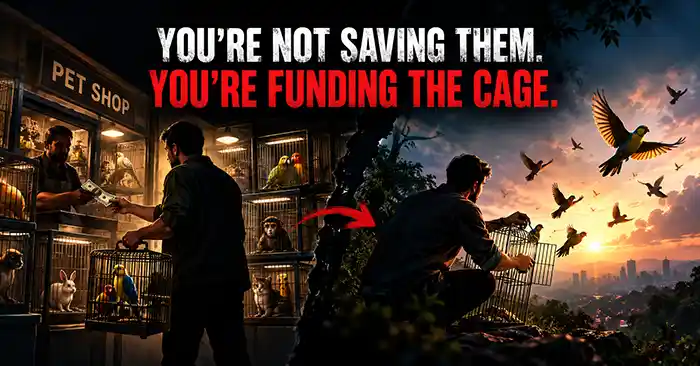
The seller has your money. The cage is empty. And somewhere in the supply chain, someone has just learned that another bird can be sold.
Congratulations. You may have rescued one animal while helping create demand for another.
And if the animal you released has never learned to find food, recognize predators, or survive in its natural environment, your act of freedom may have given it a different kind of ending.
A cage is a terrible place to live. But the world outside it is not automatically safe.
That is the uncomfortable reality of buying animals to save them. And it is time we talked about it.
What You Will Read Today
- The Pet Shop Trap: When Kindness Becomes Business
- Supply and Demand: The Animal Trade’s Favourite Customers
- Freedom Is Not Always Survival
- A Home Is Not a Habitat
- The Animal Lover’s Biggest Contradiction
- So, What Should You Actually Do?
- If You Really Love Animals, Stop Trying to Be Their Hero
The Pet Shop Trap: When Your Kindness Becomes Others’ Business
Walk into a pet shop selling caged birds or other confined animals, and you may see the same scene repeated: animals packed into limited spaces, some sitting quietly, others moving restlessly, waiting for someone to buy them.
For a compassionate person, the immediate reaction is understandable.
If I buy this one, at least it will get a better life.
And perhaps it will. An animal taken from poor conditions and placed in a suitable, caring home may genuinely benefit.
But here is the question that good intentions often forget to ask.
What happens when the seller replaces the animal you bought?
The seller is running a business. If customers continue paying for captive animals, that demand can encourage suppliers to provide more. Depending on the species and the source, that may mean breeding more animals in captivity, capturing animals from the wild, or obtaining them through other parts of the trade.
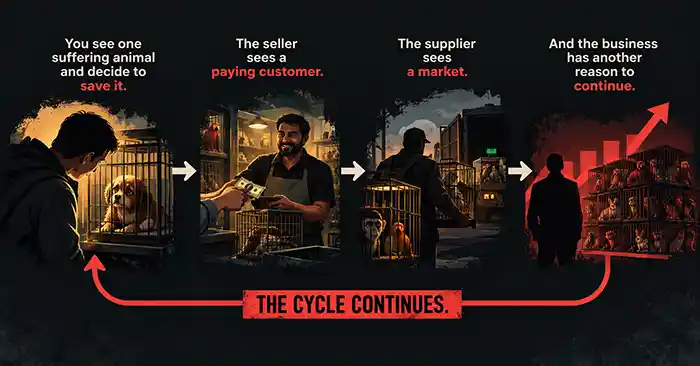
- You see one suffering animal and decide to save it.
- The seller sees a paying customer.
- The supplier sees a market.
- And the business has another reason to continue.
This is the trap. Your purchase may improve one animal’s immediate circumstances, but it can also reward the system responsible for putting animals up for sale.
Does that mean every person who buys a caged animal is cruel? No.
Does it mean every seller is involved in illegal wildlife trafficking? Absolutely not.
But it does mean that a compassionate motive does not automatically make a purchase harmless.
The animal you buy may benefit. The next animal brought in to replace it may not.
And unless you look beyond the cage in front of you, you may never see that second animal at all.
Supply and Demand: The Animal Trade’s Favourite Customers
Let’s make this simple.
A seller has ten birds for sale. Customers buy all ten. The seller notices that the birds are selling well and orders more.
If the demand continues, the supply chain has an incentive to keep supplying.
That is how markets work. Animal trading is not magically exempt from the logic.
Now imagine thousands of people buying captive animals because they feel sorry for them.
Each person may believe they are saving a life. Collectively, their purchases can help maintain a market for animals in cages.
The uncomfortable question is not how many animals you personally rescued. It is whether your actions help ensure that more animals are brought into the same conditions.
There is an important distinction here. Not every purchase leads directly to a new wild capture, and the effect depends on the species, the seller, the source, and the wider market. A responsible adoption or a properly regulated rescue is not the same as buying a wild-caught animal from an exploitative trader.
But when you cannot establish where an animal came from, and you buy it simply because seeing it suffer makes you uncomfortable, you may be rewarding a business without knowing what your money supports.
Your sympathy becomes the product’s selling point.
The more upsetting the display, the stronger the urge to intervene. The stronger that urge becomes, the easier it is for a seller to turn compassion into a transaction.
If suffering makes an animal easier to sell, your kindness can become part of the business model.
And that is a far more disturbing thought than an empty cage.
Freedom Is Not Always Survival
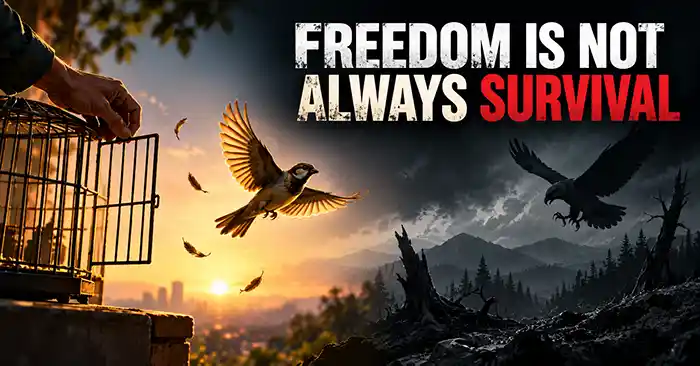
Now comes the second part of the problem.
Some people refuse to buy the animal for themselves. Instead, they pay the seller, open the cage, and release the animal outside.
The cage door opens. The animal leaves.
The person walks away believing they have done something wonderful.
But what happens next?
Can the animal find suitable food? Can it identify predators? Can it navigate its surroundings, find shelter, recognize members of its own species, and cope with local weather?
Has it developed the skills needed to survive independently?
Or has it spent so much of its life in captivity that it has never had the opportunity to develop some of those abilities?
These questions matter because opening a cage is a physical act. Returning an animal to a life it can survive is a much more complicated process.
Some captive-bred animals have never learned essential survival behaviours. Some wild-caught animals may have lost condition during captivity. Some species depend on specific habitats, social structures, or food sources. Others may be capable of surviving outside captivity but face unfamiliar threats when released in the wrong place.
There is no single answer for every animal.
A bird that belongs in a particular habitat cannot necessarily thrive in a random park. An animal accustomed to human-provided food may struggle when that food disappears. A captive animal may also carry disease or introduce pathogens to wild populations.
And if the animal is not native to the area, releasing it can create further ecological problems.
So what exactly have you achieved by opening that cage without knowing what the animal needs?
You may have given it a chance.
You may also have placed it in an environment where it cannot survive.
Freedom without preparation, suitable habitat, and the ability to survive is not a rescue plan. It is a gamble with a living creature’s life.
That does not mean animals should remain in cruel captivity because they might struggle outside it. It means their rescue needs to be handled according to their actual needs, not our emotional satisfaction.
If an animal needs rehabilitation before release, it deserves that opportunity.
If it cannot safely return to the wild, it may need a suitable sanctuary or specialised lifelong care.
And if you do not know which situation applies, the responsible choice is to seek qualified help rather than improvise.
The animal’s future should matter more than the beautiful story you tell yourself about setting it free.
A Home Is Not a Habitat
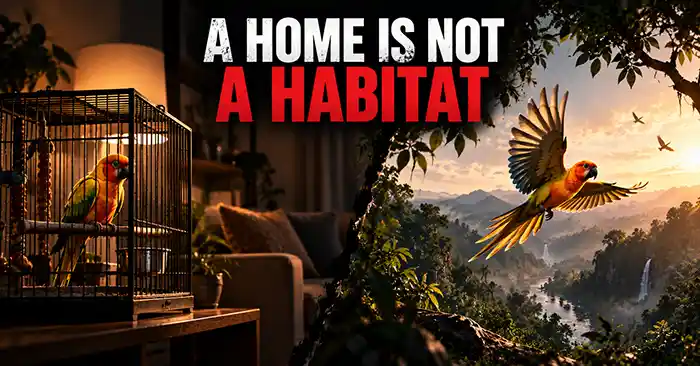
There is another assumption hiding behind the decision to buy a caged animal: that taking it home automatically makes its life better.
It might.
But a loving intention is not the same as the ability to provide appropriate care.
Different species have different requirements. Their needs may include particular diets, temperature and humidity ranges, space to move, opportunities to exercise natural behaviours, appropriate social contact, and specialised veterinary care.
Some animals need to fly over meaningful distances. Some require complex enrichment to remain physically and mentally stimulated. Others are highly social, while certain species need careful management to avoid stress or conflict.
A small cage, clean water, and regular food do not necessarily add up to a good life.
Even a large cage may fail to meet an animal’s needs if the environment is unsuitable.
And then there is the psychological cost of captivity.
An animal may experience chronic stress, boredom, fear, or frustration when it cannot perform important natural behaviours. Poor conditions can contribute to physical and behavioural problems, although the risks vary by species and individual circumstances.
People sometimes assume that an animal is happy because it eats, sits quietly, or has stopped struggling against the bars.
But quietness is not proof of contentment.
A creature that has stopped resisting may simply have learned that resistance changes nothing.
Before bringing an animal home, ask yourself some difficult questions.
Can you provide the right environment for its entire life?
Can you afford suitable food, equipment, and veterinary treatment?
Do you understand its behaviour and social needs?
What happens if you move, become busy, lose income, or can no longer care for it?
And most importantly, did you choose to care for this animal because you can genuinely meet its needs, or because you could not bear looking at it in a cage?
An animal is not a decoration for your home, and your home is not automatically a suitable habitat for it.
Care requires more than opening your wallet. It requires understanding what the animal needs, then accepting the responsibility of providing it.
The Animal Lover’s Biggest Contradiction
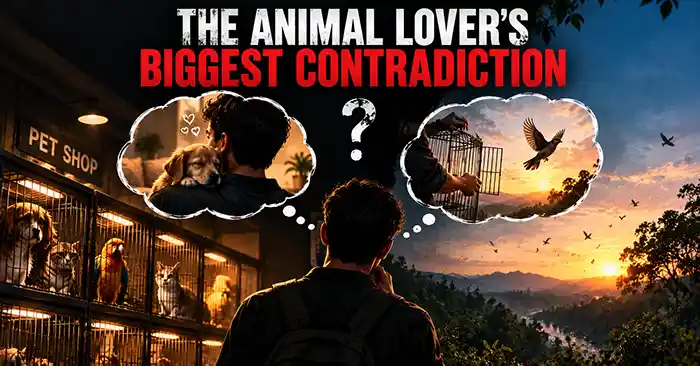
We love the idea of saving animals.
We share photographs of rescued birds. We praise people who release captive creatures. We celebrate videos of animals running into forests or flying into the sky.
The moment looks beautiful. The intention looks noble.
But we rarely ask the questions that come afterward.
Where did the animal come from?
Why was it being sold?
What happens when the seller needs another animal to meet demand?
Was the animal capable of surviving in the place where it was released?
Did it receive the care or rehabilitation it needed?
And will anyone check what happens to it after the photograph ends?
We are often more interested in witnessing a rescue than understanding whether it worked.
The emotional reward arrives immediately. The consequences may appear much later, far away from the person who made the decision.
That makes it easy to confuse feeling compassionate with acting responsibly.
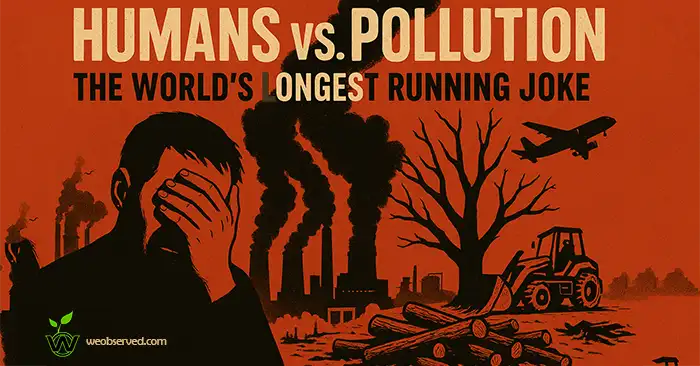
The same contradiction appears in other parts of life, too. In Humans vs. Pollution: The World’s Longest Running Joke, we examine how people can participate in the destruction they claim to oppose. Animal trading presents a similar uncomfortable question: can we claim to protect animals while our choices help sustain the conditions that harm them?
The point is not to accuse every animal lover of hypocrisy.
The point is to ask whether our idea of kindness is broad enough to include consequences we cannot immediately see.
Because the animal that matters is not just the one standing in front of us.
It is also the animal that may be captured, bred, transported, or confined because a market continues to exist.
If we care about animals, we have to care about that part of the story, too.
Must check:Humans Are Not the Problem; Definitions Are
So, What Should You Actually Do?
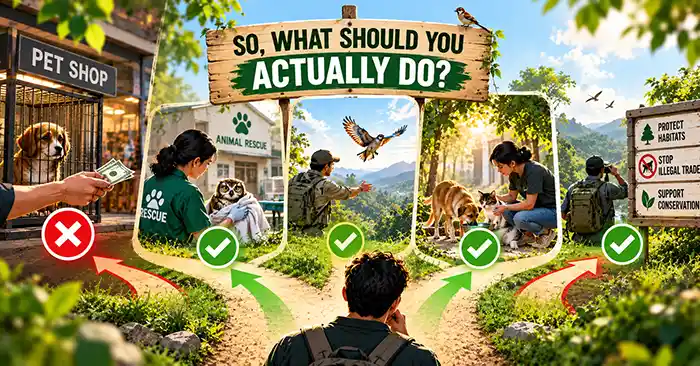
If you see a distressed animal in a pet shop, doing nothing may feel heartless. But buying it is not automatically the right answer, either.
There are better ways to help.
1. Do not purchase an animal simply to empty a cage
A purchase may relieve one animal’s immediate suffering, but it can also contribute to demand. When the source is unclear or the seller appears to be exploiting wildlife, avoid treating a transaction as a rescue.
If an animal is in immediate danger, contact an appropriate animal-welfare organisation or wildlife authority for advice.
2. Support legitimate rescue and rehabilitation
Look for reputable animal-welfare organisations, wildlife rehabilitators, and sanctuaries with appropriate expertise and facilities.
They can help assess an animal’s condition, identify its needs, and determine whether rehabilitation, release, or long-term care is appropriate.
A genuine rescue should focus on the animal’s welfare, not simply on moving it from one location to another.
3. Never release an animal without understanding the consequences
Do not assume that a park, roadside, garden, or nearby forest is a suitable release site.
Species identification, native range, health, survival skills, disease risks, and local laws may all matter.
If you encounter a captive wild animal that may need release, consult qualified wildlife professionals or the relevant authorities. In India, that may include the state forest department, depending on the species and situation.
A properly planned release can be an important part of conservation. An uninformed release can put the animal and the surrounding ecosystem at risk.
4. Give care to animals that genuinely need it
This is where ordinary people can make a meaningful difference.
You can provide water in a safe, appropriate way for local wildlife. You can support injured animals through qualified rescuers. You can adopt suitable companion animals through responsible shelters. You can help abandoned dogs and cats access food, veterinary care, sterilisation programmes, and safe shelter.
You can also support organisations that protect habitats, investigate illegal wildlife trade, and rehabilitate animals.
The right kind of help depends on the animal and the situation.
A wild bird, an abandoned domestic animal, and a captive exotic species do not have identical needs. Treating them as though they do is another form of putting our assumptions ahead of their welfare.
5. Make the demand disappear, not just the cage
Avoid buying wild-caught animals or supporting sellers whose sourcing and welfare practices cannot be verified.
Encourage responsible pet ownership. Report suspected illegal wildlife trade through the appropriate channels. Support enforcement and conservation efforts. Help others understand why releasing a captive animal without professional guidance can be dangerous.
And if you choose to adopt a companion animal, do so because you are prepared to meet its needs, not because ownership is your preferred way of expressing compassion.
The goal should not be to create a satisfying rescue moment.
The goal should be to reduce suffering without creating more of it.
If You Really Love Animals, Stop Trying to Be Their Hero
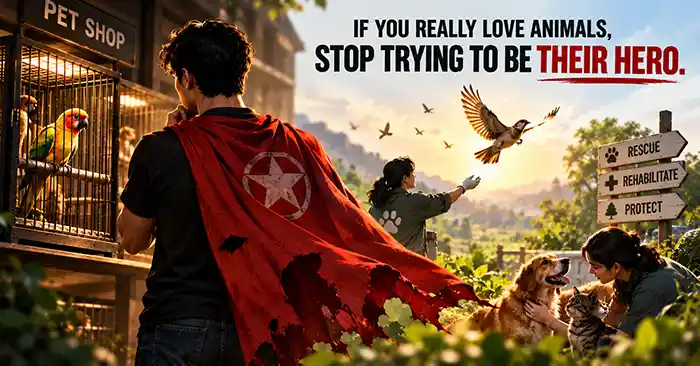
Let’s return to that bird in the cage.
You see it. You feel sorry for it. You want to do something.
That instinct is not the problem.
The problem begins when the feeling becomes the entire decision.
You buy the bird without considering the market behind it. Or you release it without considering the world it must now navigate. Or you take it home without understanding what a suitable life for that species requires.
Also check:Humans vs. Pollution: The World’s Longest Running Joke
In every case, your attention remains fixed on what you can do in that moment.
But the animal does not need you to feel heroic.
It needs you to make a decision that gives it the best chance of a healthy, safe life.
Sometimes that means supporting a professional rescue instead of purchasing the animal.
Sometimes it means helping a qualified rehabilitator return an animal to its natural habitat.
Sometimes it means providing lifelong care in an appropriate sanctuary.
Sometimes it means adopting a domestic animal that needs a home, provided you can meet its needs.
And sometimes it means stepping back, asking for expert advice, and resisting the urge to intervene in a way that could make things worse.
None of these choices offers the same instant emotional reward as buying a cage full of birds and opening its door.
But responsible care was never supposed to be about the person doing the rescuing.
It was supposed to be about the life being rescued.
So the next time you see a caged bird or animal, do not ask only, How can I save this one?
Ask, Why is this animal being sold? What will happen after I leave? And what can I do that will genuinely help?
Because if your kindness keeps the market alive, it may not be kindness in the way you imagined.
And if your freedom ends with an animal unable to survive, you have not necessarily given it a better life.
You have only opened a door.
If you truly love animals, do not make yourself the hero of their story. Help create a world in which fewer of them need rescuing in the first place.