There was a time when progress meant something simple – better roads, cleaner water, vaccines, phones that connected people. Today, it still means those things, but it also comes with quiet casualties we don’t speak about enough.
Recently, Amazon CEO Andy Jassy told employees that AI will reduce corporate roles over time. He called it an efficiency gain. And he’s not wrong. Over the past few years, we’ve seen entire departments vanish in content writing, SEO, digital marketing, data analysis, graphic design, customer service, and even coding. Jobs that required skill, effort, and creativity – all being slowly absorbed by machines that don’t sleep, don’t ask for raises, and don’t have bad days.
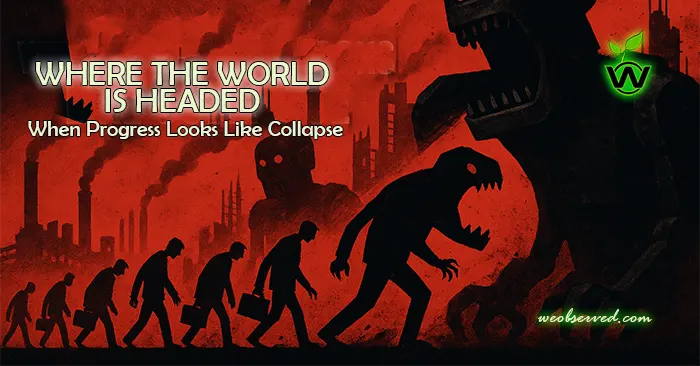
The human mind, on the other hand, does have limits. It has moods, distractions, and interests. It burns out. And for many who built their lives around such work, there’s nowhere else to go. Mid-career professionals can’t easily switch industries. Even students – hopeful teenagers trying to choose their future – are doing it in the dark. They don’t know what will still exist when they reach adulthood.
Must Check:Best New Inventions 2025 in Science, Technology and Life
It’s not just jobs. Look around.
After the pandemic, local stores began to vanish too – the kirana shops, the small sellers – because people found it easier to click than to walk. And who can blame them? But with each closed shutter, a piece of human connection disappeared.
Farmers are walking away from their land. Not because they want to, but because it no longer feeds them. Artificial food, lab-grown meat, vertical farming – all sound futuristic, but they come with silent questions: What happens to soil? To seed? To the people who spent generations in the fields? Nature isn’t something we can fully replace. But we’re trying.
Also Check:Portronics Trifusion Review: Almost the Perfect 3-in-1 Speaker
In our race to modernize, we are also eliminating the very things we rely on without even realizing it – trees, clean water, animals, bees, and microbes.
These things don’t have voices – that’s what makes them easy to kill, destroy, and ignore.
Even our connection to soil – once so natural and healing – is fading. Kids don’t play in mud anymore. In cities, people crave just the feel of touching real earth. There was a time when falling into the dirt, getting your hands messy, was part of growing up. It wasn’t just fun – it was immunity, it was grounding. Now, children get pills and syrups instead.
And what about us – the adults? The so-called working class, the backbone of the economy? Corporate employees spend their lives behind screens, buried in deadlines and KPIs, barely noticing the world outside their glass towers.
They don’t see sunsets. They don’t feel evenings. Most are just working to survive, to feed their families, not really living, just enduring.
I can’t help but feel we are accelerating toward a version of the world that’s not built for most of us. Maybe only the richest will survive, in gated cities or even off the planet. It reminds me of the movie Elysium, where Earth is reduced to chaos while the privileged orbit peacefully above.
What makes it worse?
No one’s even trying to slow down. Every new AI breakthrough, every shiny piece of futuristic tech gets a standing ovation. Applause echoes louder than concern. No one dares to ask, “At what cost?”-because the answer’s too inconvenient. It cuts expenses, boosts efficiency, and fattens their margins.
And let’s not pretend:
If you were in their shoes, you’d do the same-rip out the human, plug in the machine, save cost, grow quickly, and fill your pockets faster.
We were told technology would make life better. Maybe it has, in some ways. But for many, it’s also quietly taking life away-from livelihoods, from nature, from the human experience itself.
I don’t have a solution. I don’t even know if there is one.
I just feel the need to say it:
Progress doesn’t always mean good.
Sometimes, it just means… we’re getting faster at breaking what once made us human.