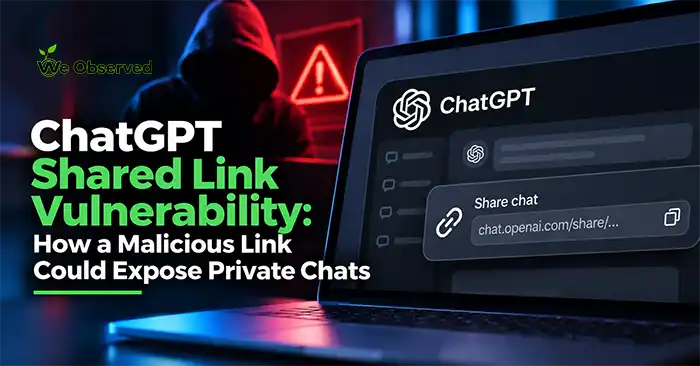
A link to a ChatGPT conversation usually looks harmless. Someone shares a useful answer, a discussion, or an example, and you open it to see what they want you to read.
But security researchers have demonstrated how a specially crafted ChatGPT shared link could do something far more serious: execute an attacker’s code inside the browser session of a logged-in user and access conversations that were never shared with the attacker.
The vulnerability was discovered by security firm Parameter. According to its research, an attacker could create a malicious shared conversation that combined ChatGPT’s HTML Preview feature with an interactive graph. By exploiting a weakness in how these features communicated, the researchers managed to escape the intended security boundary and run code with access to the victim’s ChatGPT session.
In their controlled demonstration, the researchers listed recent conversations, opened a private chat, and sent a portion of its contents to a server they controlled. They also said the same access could potentially allow actions to be performed through the victim’s account.
The issue was reported to OpenAI on October 18, 2026. OpenAI fixed it on October 26, eight days later, and the researchers said the report received a P1 priority rating. Parameter subsequently published its technical findings on October 28 and received a total bug bounty payment of $5,000.
There is an important distinction: Parameter demonstrated the vulnerability in a controlled test. It did not report evidence that criminals had exploited it against real ChatGPT users.
Also Check:Windows 11 26H2 Update: What It Does and What to Do
What Was the ChatGPT Shared Link Vulnerability?
The flaw involved a combination of features that were designed to perform different jobs.
ChatGPT allows users to share conversations through unique public links. These links make it possible for someone else to view the shared conversation without receiving access to the creator’s entire account.
ChatGPT also has a Preview feature that can turn HTML code inside a conversation into a small interactive webpage. Because HTML can contain executable code, Preview runs inside a restricted browser frame, commonly called a sandbox.
The purpose of this sandbox is straightforward: code inside the preview should not be able to access the main ChatGPT webpage or the user’s private account information.
Parameter found that this isolation could be bypassed when a shared conversation included an interactive graph that loaded a mathematical library called MathLive.
The problem was not simply that Preview could execute code. The researchers found that another component on the main ChatGPT page accepted messages from the Preview without properly checking where those messages came from.
That mistake created a route from an untrusted preview into the trusted ChatGPT webpage.
How the Attack Worked
The attack involved several steps. Understanding them does not require programming knowledge.
1. The attacker created an ordinary-looking shared conversation
The attacker prepared a ChatGPT conversation containing two elements:
- An HTML block that could be opened using the Preview feature.
- An interactive graph that loaded the MathLive library.
The conversation could then be shared using a normal ChatGPT public link.
This was important because the link did not need to look like a suspicious software download or an unfamiliar login page. It could be delivered through familiar channels such as email, a messaging app, a support ticket, or a social media post.
Must check:PS5 Games on Xbox Series X: How PS5X Works
2. The Preview opened inside a protected browser frame
When a user opened the HTML Preview, ChatGPT placed it inside a restricted browser frame on a separate web address.
This is called sandboxing. Think of it as a locked room: the preview can perform its own tasks, but it should not be able to reach into the main ChatGPT page.
According to Parameter, this part of the security design was working as intended.
The weakness appeared elsewhere.
3. MathLive accepted a message without checking its sender
The interactive graph loaded MathLive into the main ChatGPT webpage. The library included a message listener used for controlling its on-screen mathematical keyboard.
Webpages and browser frames can communicate through a browser feature called postMessage.
This communication method is useful, but it needs safeguards. The receiving page should verify the identity of the sender before accepting sensitive instructions.
Parameter found that the MathLive listener accepted a particular keyboard-related message without properly verifying its origin. The message could also contain raw HTML as part of the keyboard-layout data.
That meant the restricted Preview could send content that the trusted ChatGPT page would accept and process.
4. The injected HTML created a new browser frame
The researchers used the accepted HTML to create another frame without the expected sandbox restrictions.
The browser treated this new frame as belonging to the trusted chatgpt.com origin.
This was the critical break in the security boundary. Code that should have remained isolated could now operate in a context with access to the logged-in ChatGPT webpage.
5. A YouTube script helped execute the attacker’s code
ChatGPT’s Content Security Policy, or CSP, is designed to restrict where webpages can load executable scripts from.
The policy blocked inline scripts, but it allowed scripts from certain trusted domains, including YouTube.
Parameter used a YouTube-hosted script mechanism to get its code running through a permitted source.
This detail matters because YouTube was not the original vulnerability. It was the final technique used to get around a remaining security restriction.
Simply blocking YouTube would not have fixed the underlying problem. The real issue was that untrusted HTML had already crossed into the trusted page.
Must check:Nothing Headphone (1) Pro Review: Is It Worth $399?
What Could an Attacker Access?
Once the code was running with the victim’s signed-in ChatGPT session, the researchers could interact with ChatGPT’s authenticated APIs.
In their demonstration, they showed that the code could:
- List the victim’s recent conversations.
- Open a private conversation that had never been shared with the attacker.
- Read part of that private conversation.
- Send the extracted information to a server controlled by the researchers.
The code did not need to take screenshots or copy information that happened to be visible on the screen. It called ChatGPT’s own signed-in APIs directly.
Parameter described the potential reach in strong terms: “Essentially, we could perform any action on behalf of the victim’s ChatGPT account.”
That statement describes the researchers’ assessment of the access they achieved. It should not be interpreted as proof that every possible account action was tested or that every ChatGPT account was compromised.
A practical example: How private information could be exposed
Imagine using ChatGPT to discuss a confidential business proposal.
Your conversation includes:
- Internal pricing information.
- Customer names.
- Unpublished product plans.
- Financial projections.
- Draft messages to business partners.
You later receive a shared ChatGPT link from an unfamiliar sender. It appears to contain a useful discussion, so you open it while logged in to your ChatGPT account.
In the demonstrated attack scenario, the malicious conversation could use the Preview and graph combination to execute code in your signed-in session. That code could then access private conversations through authenticated APIs and send selected information outside the account.
The attacker would not need to know your password or persuade you to enter it into a fake login page.
This is why the vulnerability was more serious than an ordinary misleading link. The researchers demonstrated access through an existing authenticated session.
How Many Steps Did the Attack Require?
The researchers described two versions of the attack.
| Attack version | User interaction |
|---|---|
| More reliable demonstration | Open the shared link and click the Preview button once |
| Later version | Open the shared link, with Preview configured to open automatically |
In the later version, opening the link was the only required user action, according to Parameter’s report.
The victim did not need to:
- Download an application.
- Install a browser extension.
- Join the attacker’s workspace.
- Enter their password into an attacker-controlled website.
- Give the attacker direct access to their account.
That reduced interaction is what made the vulnerability particularly concerning.
What Did OpenAI Fix?
Parameter reported the vulnerability through OpenAI’s bug bounty program on October 18, 2026.
The reported timeline was:
| Date | Event |
|---|---|
| October 18, 2026 | Parameter reported the vulnerability to OpenAI |
| October 26, 2026 | OpenAI’s fix was confirmed across two versions of the web frontend |
| October 28, 2026 | Parameter published its technical research |
| October 31, 2026 | The Hacker News published its report on the discovery |
The researchers said OpenAI initially assigned the report P2, then raised it to P1. The fix was implemented across two versions of ChatGPT’s web frontend, which rejected the messages used in the attack.
Parameter also reported receiving a total of $5,000 through OpenAI’s bug bounty program.
The researchers identified three connected weaknesses:
- Insufficient sender verification: MathLive accepted a message without properly checking which browser frame had sent it.
- Unsafe HTML handling: The message could carry raw HTML as keyboard-layout data.
- An unintended trusted frame: The injected HTML could create a frame that inherited the
chatgpt.comidentity without the expected sandbox restrictions.
The YouTube script was a workaround used during the final stage, not the root cause.
Must check:OpenAI Mathematics: What the 377 Results Actually Show
Was This Vulnerability Used to Steal Real ChatGPT Conversations?
Parameter did not report real-world exploitation of this vulnerability.
Its demonstration was conducted in a controlled environment using separate accounts. The researchers tested whether one account could access private conversation data belonging to another account under the attack conditions.
That distinction is important. A successful proof of concept establishes that an attack is technically possible. It does not establish that criminals used it against ordinary users.
There is also no reported public statistic showing how many ChatGPT users were exposed, how many malicious links were distributed, or whether any private conversations were stolen through this particular flaw.
The vulnerability was fixed before Parameter published its detailed research.
Do ChatGPT Users Need to Change Their Passwords or Update Anything?
No action is required for this specific vulnerability, according to the published report.
OpenAI implemented the fix on its side. Users do not need to install a patch, reset their ChatGPT account, or change a setting to receive it.
However, sensible link-sharing habits remain important.
What users should do
1. Be careful with unfamiliar shared links
A link to a ChatGPT conversation can be used to deliver content, not just information. Treat unexpected links with the same caution you would apply to unfamiliar email attachments.
2. Check the source of the link
Official ChatGPT shared links use the address format:
https://chatgpt.com/share/
This helps identify the expected shared-link format, but it does not guarantee that the content itself is trustworthy. A legitimate shared link can still contain misleading or harmful material.
3. Avoid running unfamiliar previews
If a shared conversation contains an unexpected interactive preview, graph, or other embedded content, consider whether you actually need to open it.
4. Avoid putting highly sensitive information into shareable conversations
ChatGPT’s shared-link documentation warns that anyone with access to a shared link can view the conversation included in it. Review the content before sharing and avoid including confidential information unnecessarily.
5. Review and remove old shared links
OpenAI provides shared-link management under:
Settings > Data Controls > Shared links
You can review existing links and delete individual links or remove all of them. Deleting a shared link prevents further access through that URL, although someone who previously imported the conversation may still have a copy in their own chat history.
These are general privacy practices, not emergency steps required to resolve the patched vulnerability.
Why This Incident Matters Beyond ChatGPT
The incident highlights a broader problem in web security: individual features can appear safe while the way they communicate creates an unexpected weakness.
In this case, the Preview sandbox was designed to isolate untrusted code. The weakness emerged because a separate component on the main page trusted a message it should have verified.
It is similar to installing a secure door but leaving a service hatch open. The door works correctly, yet another route allows someone to cross the boundary.
There are three wider lessons.
1. Sandboxing is only as strong as the systems around it
A sandbox cannot guarantee safety if another trusted component accepts unsafe instructions from inside it.
Web applications need to verify the origin of messages passed between frames, validate the data they receive, and avoid inserting untrusted HTML directly into trusted pages.
2. Third-party libraries can become part of the security boundary
MathLive was used for mathematical input, not account management. Yet its message-handling behavior became part of a chain that affected account security.
This demonstrates why developers must assess how external libraries interact with the rest of an application, especially when those libraries can communicate with browser frames or process HTML.
3. An authenticated browser session is valuable to attackers
Many people focus on protecting passwords. But once a user is logged in, the browser already holds the authentication state needed to access account features.
If malicious code executes inside the trusted website’s context, it may be able to use that existing access without asking for the password again.
That is why preventing cross-site scripting, unsafe message handling, and sandbox escapes remains essential.
Final Verdict: The Vulnerability Is Fixed, but the Security Lesson Remains
The ChatGPT shared-link vulnerability showed how an ordinary-looking conversation link could become a route into a user’s private account.
Parameter demonstrated that a carefully constructed conversation combining HTML Preview and an interactive graph could bypass the intended browser isolation. In its controlled test, the researchers accessed private conversations through the victim’s authenticated session and transferred part of the data externally.
OpenAI fixed the reported issue eight days after receiving it, and Parameter reported no real-world exploitation. Users do not need to install anything or reset their accounts because of this specific flaw.
But the incident deserves attention for a reason beyond the $5,000 bug bounty or the technical details. People increasingly use AI conversations to discuss work, finances, personal matters, research, and confidential plans. The information stored in those conversations can be valuable, and protecting it requires more than a strong password.