
Most smart home devices solve one job. A smart speaker plays music and answers questions. A security camera shows you what’s happening outside. A smart display adds a screen for recipes, video calls and household controls.
Apple HomeView attempts to bring all those experiences together in one place, with a feature that makes it different from a conventional smart display: it can recognise individual members of a household and tailor the experience to each person.
Announced at Apple’s Welcome Home event on October 13, 2026, HomeView combines a seven-inch Liquid Retina display, Siri AI, a speaker system, FaceTime, entertainment apps and smart home controls. It is available to preorder for $299 in the US and £299 in the UK, with availability scheduled to begin on November 13, 2026.
The promise is attractive. Imagine walking into the kitchen and seeing your reminders, checking a delivery camera from the hallway, or making a video call without finding your iPhone. For an Apple household, that could make everyday routines easier.
But HomeView also asks you to pay a premium for a device that overlaps with products you may already own.
So the important question is not whether Apple has made an impressive smart display. It is whether HomeView offers enough practical value to earn a permanent place in your home.
What is Apple HomeView?
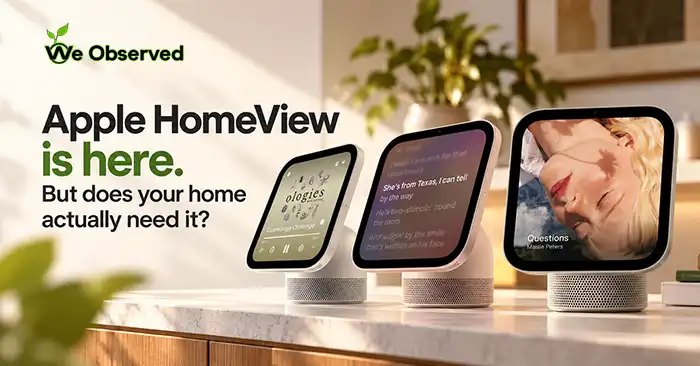
Apple HomeView is a smart home display designed to sit on a countertop, bedside table or other shared surface. A separate wall-mounted version is available for spaces such as hallways and entryways.
The standard model places a seven-inch screen above a domed speaker base. Its stainless steel hinge lets you adjust the viewing angle, while the interface adapts to your distance from the display, presenting simpler information when you are farther away and more detail when you approach.
Apple positions HomeView as a central screen for entertainment, communications and home management. Rather than treating it as a large voice assistant, the company wants it to become a shared household interface that still respects each person’s private information.
That distinction is important. In a family home, one person may want to check a calendar, another may want to play music, and someone else may want to control the lights. HomeView is designed to accommodate those different needs without treating everyone as the same user.
Apple HomeView specifications at a glance
| Feature | Details |
|---|---|
| Display | 7-inch Liquid Retina touchscreen |
| Processor | Apple A18 chip |
| Voice assistant | Siri AI, powered by Apple Intelligence |
| Personalisation | Facial recognition for up to six household members |
| Brightness | Up to 500 nits, down to 0.3 nits |
| Audio | Two full-range drivers, down-firing woofer and two passive radiators on the tabletop model |
| Video calls | FaceTime with Center Stage |
| Entertainment | Apple Music, Apple Podcasts, Apple News, Apple TV and compatible third-party apps |
| Smart home | Compatible Apple Home, HomeKit and Matter accessories |
| Camera dashboard | Up to nine live camera feeds |
| Tabletop colours | Silver, Starlight, Rose Pink and Space Grey |
| Wall-mounted colours | Silver and Space Grey |
| US price | $299 |
| UK price | £299 |
| Availability | November 13, 2026 |
Specifications are based on Apple’s published product information. The wall-mounted model uses audio hardware tuned for on-wall placement, so its acoustic configuration differs from the tabletop version.
The feature that matters most: HomeView knows who is using it
The headline feature is personalisation.
Apple says HomeView can recognise up to six people and provide each with a personalised Home Screen containing their own apps and widgets. Personal content can include information from Messages, FaceTime, Calendar, Reminders and Find My, while shared photo albums and music remain accessible to the household.
This could be genuinely useful in a busy home.
A shared display often creates a small but persistent problem: whose information should appear on it? A calendar reminder might be relevant to one person but not another. A message preview could be private. A playlist that suits one family member may not suit the next.
HomeView’s user recognition is intended to reduce that friction.
However, personalisation is only valuable if recognition works reliably in your household and if family members are comfortable with a camera-based system in a shared space. Buyers should consider where the device will sit, who can see its screen, and how each household member will configure their account.
There is also a compatibility requirement. Apple’s store information says household members need an Apple Account and a compatible, updated iPhone or iPad to enrol. That makes HomeView a more natural fit for Apple-centric households than for homes where family members use a mixture of platforms.
Siri AI: The reason HomeView could be more useful than a normal smart display
HomeView is built around Siri AI, Apple’s updated assistant powered by Apple Intelligence.
Apple says Siri AI can handle more natural conversations, answer general-knowledge questions and offer improved music discovery. When paired with a compatible Apple Intelligence-enabled iPhone or iPad, it can also use personal context from apps such as Messages and Calendar to provide more relevant responses.
That personal context could be the difference between a generic voice assistant and a genuinely useful household helper.
For example, a user might ask about an upcoming appointment, request a reminder or find a relevant playlist without manually opening multiple apps. In the kitchen, HomeView can display recipes, guide users through steps and help manage timers.
Still, there is a difference between an assistant that understands a request and one that completes it reliably. Buyers should wait for independent testing of common household tasks before assuming Siri AI will always interpret requests correctly.
Availability is another consideration. Apple lists Siri AI on HomeView in English in the US, UK, Australia, Canada, India, New Zealand, Singapore and South Africa at launch. The company’s regional support and software requirements should be checked before ordering.
Privacy: A useful promise, but placement still matters
A device that recognises faces and accesses personal information deserves closer scrutiny than a basic speaker.
Apple says HomeView is designed with privacy and security at its core. Siri requests can be processed on-device or through Private Cloud Compute. According to Apple’s published explanation, data processed through Private Cloud Compute is not stored or made accessible to Apple.
That is an important part of the product’s pitch, but it should not end the privacy discussion.
HomeView is intended for shared spaces. A household should decide where the screen belongs, which people can access it, and whether a kitchen, bedroom or hallway is the right place for a camera-equipped display.
Users should also understand which features require compatible accessories or an iCloud+ subscription. Apple’s smart camera features can include recognition of familiar faces, pets, packages and vehicles, alongside video descriptions for supported HomeKit Secure Video footage. These capabilities are not all provided by the display alone.
The practical takeaway: Apple’s privacy architecture is a meaningful selling point, but the best privacy outcome also depends on how a household configures and uses the device.
Entertainment and audio: More than a screen for your lights
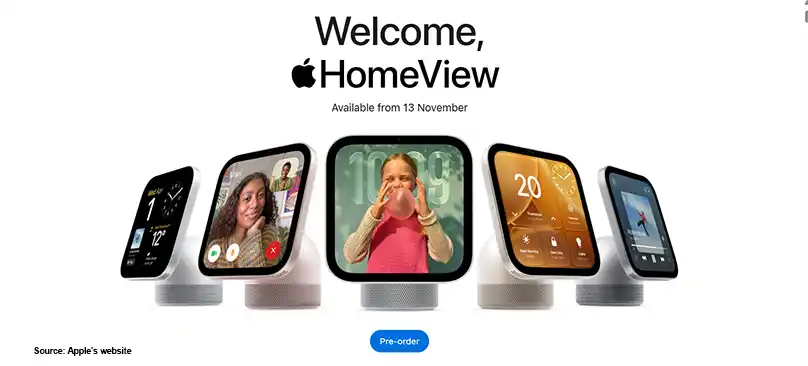
HomeView also aims to be a compact entertainment device.
The tabletop model combines two full-range drivers with a down-firing woofer and two passive radiators. Apple says computational audio adjusts bass response and loudness at different volume levels, and the device supports Spatial Audio.
Users can access Apple Music with animated album artwork and lyrics, Apple Podcasts, Apple News, Apple TV and compatible third-party audio and video apps. Multiple HomeView devices, HomePods and AirPlay-compatible speakers can be configured for multiroom audio.
FaceTime with Center Stage is another practical addition. It can keep participants framed as they move around during a call, making the device useful for quick conversations in the kitchen or living room.
These features make HomeView more versatile than a screen used only for smart home controls. But buyers should not assume that a compact speaker base will replace a dedicated stereo system or a television. Its value depends on whether you want convenient, always-available household entertainment rather than a full home theatre experience.
Smart home control: A dashboard that needs compatible devices
HomeView can control supported lights, thermostats, locks and blinds using touch or Siri AI. Its Home Camera interface can display up to nine live camera feeds at once, giving users a convenient view of the home from a central screen.
Apple has also introduced the Apple Home Collection, a range of cameras, thermostats and a lock developed with LG Electronics and Schneider Electric. These accessories are intended to work with Apple Home, alongside compatible HomeKit and Matter devices. The collection is scheduled to arrive later, so buyers should check individual accessory availability rather than assume every product is ready at launch.
Compatibility deserves particular attention before spending money. A smart home can contain devices bought over several years, from different manufacturers. Check whether your existing lights, locks, cameras and thermostats are supported by Apple Home or Matter.
If your current devices are incompatible, the cost of moving to HomeView could extend well beyond the $299 display.
Apple HomeView price: Is $299 worth it?
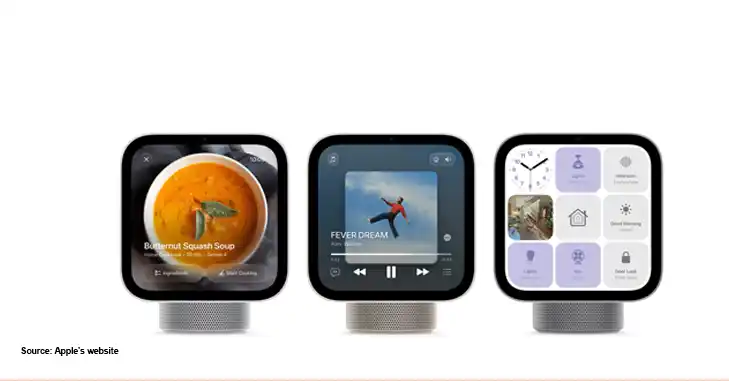
Apple HomeView costs $299 in the US and £299 in the UK for both the tabletop and wall-mounted versions. Pre-orders are open, and availability is scheduled for November 13, 2026.
The wall-mounted model requires a separate power and mounting solution. In the UK, Apple’s listed options start at £54.95 for the Power Mount USB-C Wall Connector and £69.95 for the Power Mount AC Wired. A Power over Ethernet mount is planned for early 2027 at £119.95. In the US, the corresponding first two accessories start at $59.95 and $79.95.
That means the wall-mounted version may cost more than its headline price once the required hardware is included.
Is it worth paying more than you would for a basic smart display?
That depends on what you already own and what you expect the device to do.
HomeView’s main advantage is its integration with Apple’s ecosystem. If your household uses iPhones, Apple Music, FaceTime, Apple Home and compatible smart accessories, it can bring several everyday tasks into one shared interface.
If you mainly want to ask the weather, set a timer, play background music or check a camera feed, a cheaper smart display may be sufficient. HomeView’s premium is harder to justify if you will use only a fraction of its capabilities.
The key question is whether you will use the personalisation and household integration every day. If the answer is no, the display may become an expensive screen that duplicates your phone.
Apple HomeView vs Amazon Echo Show and Google smart displays
The closest comparison is not a traditional tablet. It is a smart display that stays in one place and helps manage a household.
Amazon’s Echo Show range and Google-compatible smart home devices already cover many everyday needs, including voice commands, entertainment, video calls on supported models and smart home controls. Their main appeal is that buyers can choose from different prices and device sizes.
HomeView’s differentiation is its combination of Apple’s personal context, user recognition and integration with Apple services. The trade-off is that buyers get the most value when their household already uses compatible Apple devices.
| Buyer priority | HomeView may suit you if… | Compare alternatives if… |
|---|---|---|
| Personalised household screens | Several family members use compatible Apple devices | Your household uses a mix of platforms |
| Smart home control | Your accessories work with Apple Home or Matter | You rely on devices outside Apple’s supported ecosystem |
| Entertainment | You use Apple Music, FaceTime and Apple services regularly | You mainly need basic music playback or a screen for occasional tasks |
| Budget | You value integration enough to pay $299 | Price is more important than ecosystem features |
| Wall installation | You want a dedicated display in a hallway or entryway | You prefer a portable device with no extra mounting cost |
There is no universal winner here. The right choice depends on the household’s existing devices, the features that will be used regularly and the total cost of any required accessories.
Apple HomeView availability: What US and UK buyers should know
Apple has opened pre-orders in the US and UK. Both the tabletop and wall-mounted models are listed at $299 in the US and £299 in the UK, with availability beginning November 13, 2026. The tabletop version comes in Silver, Starlight, Rose Pink and Space Grey; the wall-mounted version is offered in Silver and Space Grey.
One important regional exception is the European Union. Apple says HomeView is not currently available for sale in the EU because Siri AI is unavailable in iOS there, and it is working with the EU to find a path forward. UK availability is separate from EU availability.
For the most accurate ordering information, check the relevant regional Apple Store and the official Apple Newsroom announcement rather than relying on an older event preview.
What else did Apple announce at the Welcome Home event?
HomeView was the headline product, but Apple’s Welcome Home event also expanded its smart home and entertainment lineup.
The announcements included HomePod mini 2, an updated Apple TV 4K and the Apple Home Collection of smart home accessories developed with LG Electronics and Schneider Electric. The broader direction is clear: Apple wants its home devices, services and AI assistant to work together more closely.
For buyers, the surrounding lineup matters because HomeView is more valuable as part of a connected system than as an isolated gadget. Someone who already owns HomePods and compatible smart accessories may find it easier to justify than someone starting from scratch.
What about Apple stock?
The launch may be relevant to investors watching Apple’s services, hardware and smart home strategy, but a single product announcement is not enough to predict the direction of Apple stock. Investors would need to consider the device’s sales, margins, adoption, competition and contribution to Apple’s wider business over time.
The same caution applies to claims about the company’s market position. HomeView expands Apple’s offering, but its long-term impact will depend on customer adoption rather than the announcement alone.
Frequently asked questions
What is Apple HomeView?
Apple HomeView is a smart home display with a seven-inch Liquid Retina touchscreen, Siri AI, a speaker system, FaceTime, entertainment apps and controls for compatible smart home accessories.
How much does Apple HomeView cost?
It costs $299 in the US and £299 in the UK for both the tabletop and wall-mounted versions. The wall-mounted model requires additional mounting and power hardware.
When does Apple HomeView go on sale?
Apple has scheduled availability to begin on November 13, 2026. Check your regional Apple Store for current ordering details.
Can HomeView recognise multiple people?
Yes. Apple says it can recognise up to six household members and provide each with a personalised Home Screen. Enrolment requires compatible Apple accounts and devices.
Is Apple HomeView available in the UK?
Yes. Apple lists the device for preorder in the UK at £299, with availability beginning November 13, 2026.
Is Apple HomeView available in the European Union?
Not currently. Apple says Siri AI is unavailable in iOS in the EU and that HomeView is therefore not available for sale there at this time.
Does HomeView require an iCloud+ subscription?
Some advanced smart camera features, including supported recognition and video descriptions for HomeKit Secure Video, require a compatible camera setup and an iCloud+ subscription. Not every HomeView feature requires iCloud+.
Where can I find official Apple HomeView information?
Apple’s official product pages and the Apple Newsroom announcement provide the most reliable starting points for specifications, regional pricing, availability and software requirements.
Final verdict: A smart display for Apple households, not everyone
Apple HomeView is most compelling when viewed as a shared interface for a household already invested in Apple’s ecosystem. Personalised screens, Siri AI, FaceTime, entertainment and smart home controls could make everyday tasks more convenient, especially when several family members share the same space.
Its limitations are equally important. The $299 price is substantial for a device that overlaps with phones, speakers and existing smart displays. Wall mounting adds cost, compatibility needs checking, and the value of personalisation depends on whether a household actually uses it.
My buying advice: consider HomeView if you want a permanent household screen and already rely on Apple devices and services. If your needs stop at voice commands, music and a few smart lights, compare cheaper alternatives before ordering.
The Welcome Home event signals Apple’s intent to make its ecosystem more central to daily life. Whether HomeView earns its place on your counter will depend on how much of that integration you genuinely need.